
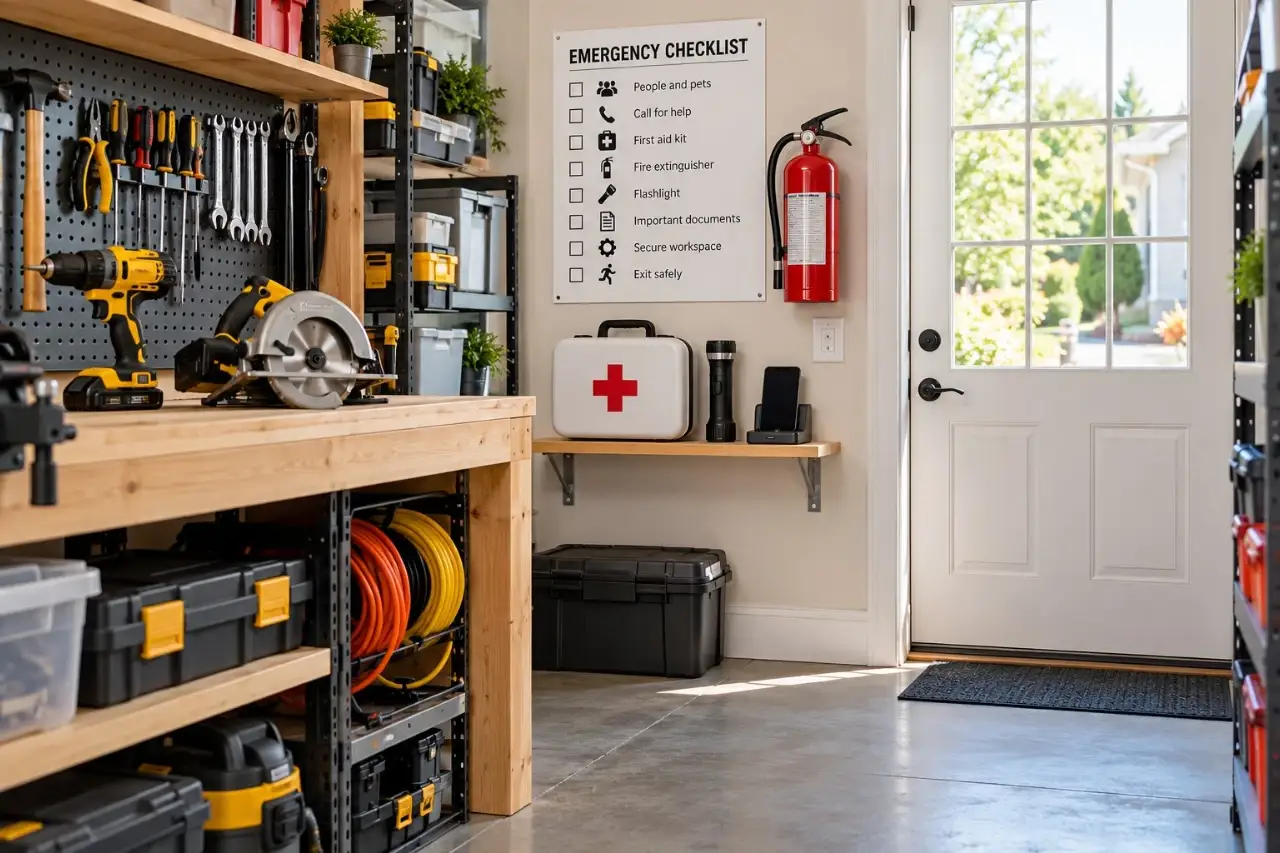
A workshop emergency response checklist gives DIYers a clear order of operations when something goes wrong: protect people first, stop the hazard only when it can be done safely, call for help when needed, provide appropriate basic first aid, and do not restart work until the cause has been identified.
Keep the checklist visible near the workshop exit instead of storing it where it cannot be reached during an emergency.
The first 60 seconds: protect people first
An emergency can become more serious when someone tries to save a tool, finish a cut, or clean up a spill before addressing immediate hazards. Your first priority is protecting yourself and others. A damaged tool, project, or workbench can be replaced.
Use this sequence:
- Stop work. Release the trigger, switch off the tool, and place it in a safe position if you can do so without moving toward the hazard.
- Shut off the energy source only if it is safe. Unplug a corded tool by the plug, switch off equipment using its normal control, or move away from a damaged cordless battery. Do not reach through smoke, flames, standing water, or a chemical spill to do this.
- Create distance. Keep people away from moving blades, falling materials, fumes, smoke, broken glass, or damaged electrical equipment.
- Call 911 for immediate threats. Examples include fire, significant bleeding, trouble breathing, loss of consciousness, suspected electric shock, serious eye injury, or any situation you cannot control safely.
- Get help when available. Ask another person to meet emergency responders and guide them to the workshop, garage, shed, or basement entrance.
If there is no immediate threat to life, secure the area and assess what happened before cleanup. A near-miss deserves attention because it can reveal problems with tool condition, guards, setup, storage, or workspace organization.
Fire, smoke, and overheating tools
| Preview | Product | Price | |
|---|---|---|---|

| Kidde Basic 110 Fire Extinguisher for Home, 1-A:10-B:C, FA110G, 2 Pack |
$35.95 | View on Amazon |
A burning tool, extension cord, dust collector, finish rag, or lithium-ion battery requires leaving the area if the fire is growing, producing heavy smoke, or cannot be handled immediately with the correct extinguisher. Alert others, exit the area, close doors behind you when practical, and call 911.
Only attempt to use a fire extinguisher when the fire is small and contained, you have a clear escape path, and you know how to operate the extinguisher. Do not fight a fire that is spreading, involves unknown chemicals, or could trap you.
When a battery overheats or smokes
A lithium-ion battery that becomes unusually hot, swells, hisses, leaks, smokes, or catches fire needs extra caution. Stop using the tool or charger. Do not touch a hot, swollen, or damaged battery pack, and do not place it in a sealed container, household trash, or water.
Keep people away and call 911 if there is smoke, fire, or concern that the battery may ignite. After the event, follow the tool manufacturer’s instructions for damaged battery handling and disposal. Do not open, rebuild, or attempt to repair the battery pack or charger.
Dust and oily rags need different thinking
Fine wood dust can ignite when it accumulates near ignition sources such as sparks, heaters, or damaged electrical equipment. Use dust cleanup methods appropriate for your vacuum and filter system rather than spreading dust through the shop with compressed air.
Rags used with certain oils, stains, and finishes can generate heat during curing. Follow the product label for temporary storage and disposal. If a container or pile of rags feels warm, smells unusually strong, or smokes, move away and seek emergency help rather than handling it casually.
Injuries: stop work, then match the response to severity
| Preview | Product | Price | |
|---|---|---|---|

| 24/7 First Aid OSHA Compliant First aid Kit, All-Purpose 100-Person Emergency First Aid Kit for… | $37.99 | View on Amazon |
Keep a stocked first-aid kit where it can be reached without crossing the main tool area. Everyone who uses the shop should know its location, the property address, and the quickest exit route.
For a minor cut or scrape, stop work, clean and cover the injury, and use a new bandage. Do not continue using a saw, drill, or sander with a painful hand injury or loose protection that could interfere with safe tool operation.
For severe bleeding, a deep cut, an amputation, an embedded object, a crush injury, or an injury involving a powered blade, call 911. Apply firm direct pressure with clean cloth or gauze if it is safe to do so, but do not remove embedded objects. Follow the directions of emergency dispatchers until help arrives.
Eye injuries require caution. Flush minor dust or loose debris with clean water at an eyewash station or sink. Do not rub the eye or attempt to remove particles that are embedded, stuck, or caused by a high-speed tool. Seek urgent medical care for pain, vision changes, chemical exposure, or objects in the eye.
Electric shock and damaged cords
If a person is in contact with a suspected live electrical source, do not touch them until the power is disconnected. Call 911, shut off power at the normal disconnect only if it can be done safely, and wait for guidance.
After any cord, plug, outlet, or tool fault, remove the equipment from service and label it so nobody uses it. Warning signs include a burning smell, sparks, repeated breaker trips, tingling, a hot plug, cracked insulation, or a loose outlet. Do not cover damaged insulation with tape or continue testing faulty equipment. Contact the manufacturer, an authorized service center, or a qualified electrician depending on the issue.
Chemical spills, fumes, and dust exposure
Read product labels and safety instructions before using finishes, solvents, adhesives, cleaners, or other workshop chemicals. Labels provide the required information for ventilation, protective equipment, cleanup, and emergency response.
For a small spill, identify the product before cleanup. Move ignition sources away if safe, ventilate only as the label permits, and use the recommended cleanup method. Never mix cleaners or chemicals. If fumes cause dizziness, nausea, breathing difficulty, or confusion, move to fresh air and contact emergency services or Poison Control at 1-800-222-1222 in the United States.
For an unknown, large, or highly flammable spill, isolate the area and call 911. Do not wash chemicals down floor drains or storm drains. Follow local hazardous-waste guidance after the immediate danger is controlled.
Build the checklist around your actual workshop
| Preview | Product | Price | |
|---|---|---|---|

| First Alert Battery Smoke Alarm |
$29.99 | View on Amazon |
A useful workshop emergency response checklist is specific enough to use under stress. Post it at eye level near the main exit and review it when you rearrange the shop, add stationary equipment, or begin using new finishes or adhesives.
Include these details:
- Your full street address, including unit number if applicable
- Locations of exits, first-aid kit, fire extinguisher, flashlight, and phone
- Main electrical shutoff location for reference
- Emergency contacts and the Poison Control number
- Location of safety data sheets or product labels for shop chemicals
- Reminder to keep exits, electrical panels, and fire extinguishers unobstructed
Do not assume every extinguisher, eyewash product, or cleanup method suits every hazard. Check equipment instructions and chemical labels. Local requirements can vary, especially for detached shops, apartments, sheds, and workshops that store flammable finishes or fuels.
After the emergency: prevent the next one
Once everyone is safe and emergency response is complete, do not simply replace a blade or reset a breaker and continue working. Remove the tool or material from service and identify the contributing condition: poor lighting, cluttered exits, a dull blade, an overloaded extension cord, missing work support, inadequate dust collection, distraction, or rushed setup.
Correct the condition before returning to the task. If you cannot identify the cause of overheating, repeated electrical faults, binding, or unexpected tool behavior, stop using the equipment and contact the manufacturer or a qualified service professional.
Ulverion is reader-supported. Your support allows us to research tools, create practical guides, and share reliable DIY advice for homeowners, makers, and workshop enthusiasts.