
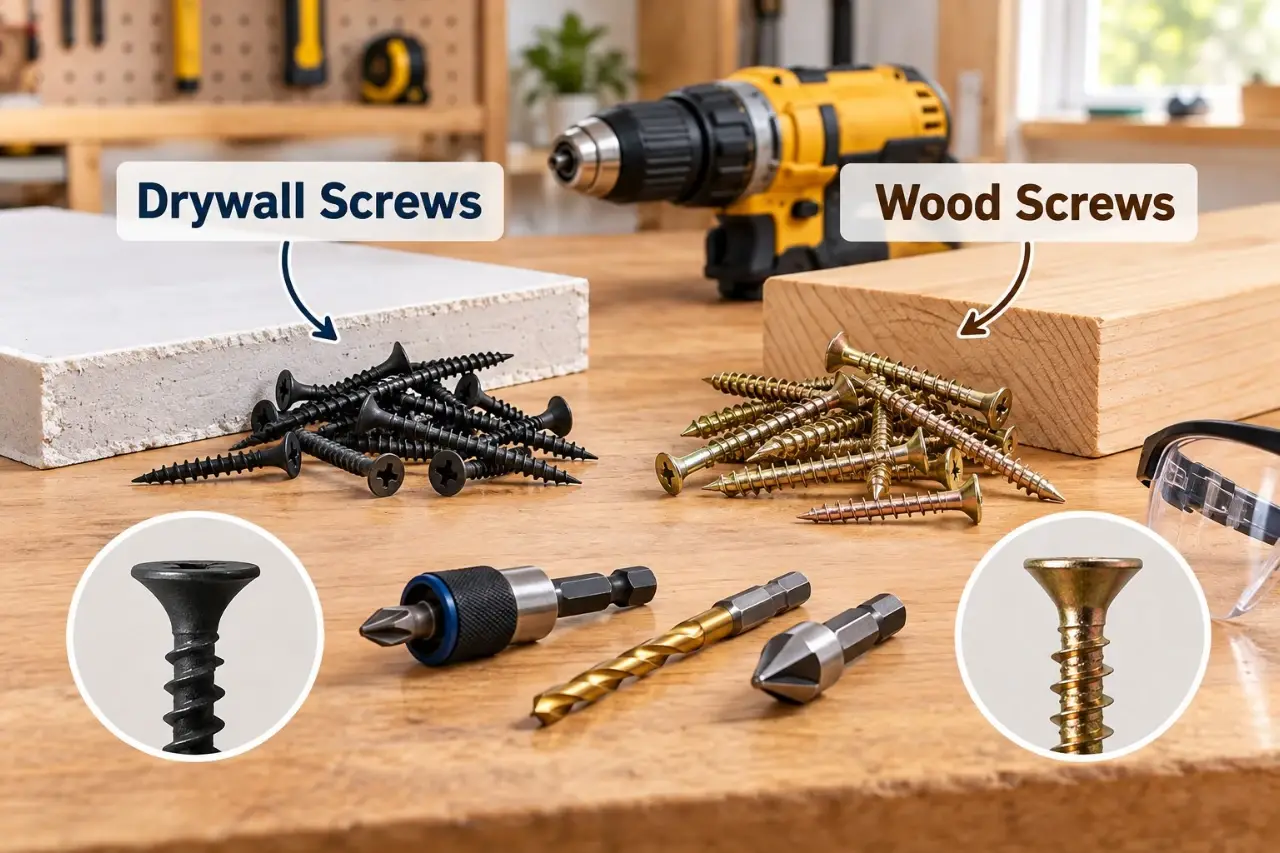
Drywall screws and wood screws are not interchangeable. Use drywall screws to attach gypsum board to approved framing, and use wood screws for wood-to-wood assembly or hardware when the screw is rated for that job.
Drywall screws use a bugle head and drywall-specific thread designs to seat below the paper face without tearing it.
Wood screws vary more in head, shank, thread, and coating because they are designed for different wood connections and environments.
Drywall screws vs. wood screws at a glance
| Feature | Drywall screw | Wood screw |
|---|---|---|
| Primary job | Attach gypsum board to approved framing | Join wood parts or attach approved hardware to wood |
| Typical head | Bugle head | Flat, pan, washer, trim, and other task-specific styles |
| Thread design | Depends on the framing type and drywall system | Depends on wood type, screw design, and application |
| Finish | Commonly an interior drywall coating such as phosphate | Interior, exterior, or treated-lumber-compatible finishes are available |
| Best advantage | Seats slightly below the drywall face for finishing | Provides clamping and thread engagement suited to wood |
| Do not assume | Suitable for structural or exterior work | Suitable for hanging drywall or for structural loads |
Neither category should be treated as automatically structural. A general-purpose wood screw is not the same thing as an evaluated structural screw, and a drywall screw should not be substituted for a structural fastener.
What makes a drywall screw different?
A drywall screw is designed to fasten gypsum panel products to framing. Its bugle-shaped head spreads the seating force over the paper face and allows the head to finish slightly below the surface so joint compound can cover it.
Thread style matters because framing materials differ. Coarse-thread drywall screws are commonly used with wood framing, while fine-thread screws are commonly used with light-gauge steel framing. Standardized gypsum fastener designations are more precise: Type W screws are intended for wood framing, while Type S screws are used with light-gauge steel and may also appear in some wood-framed systems. Thicker steel framing can require a different screw type.

Do not choose a screw only by whether it looks coarse or fine. Follow the gypsum-board or tested-assembly instructions for the required screw type, length, spacing, and penetration.
Drywall screw length is not one-size-fits-all
A 1-1/4-inch Type W screw is common in many single-layer wood-framed drywall applications, but that does not make it a universal rule. Board thickness, framing, wall versus ceiling location, multiple layers, and fire- or sound-rated assemblies can change the required fastener.


For that reason, avoid relying on a generic “board thickness equals screw length” chart for every installation. Use the panel manufacturer’s instructions and any assembly-specific requirements.
Seat the head without breaking the paper
A correctly driven drywall screw sits slightly below the panel surface while the face paper remains intact. If the screw cuts through the paper, that fastening point loses much of the support provided by the paper face.

A drywall screw gun or a depth-setting screw setter bit makes repeatable depth easier. With a drill/driver, use controlled speed and a conservative clutch setting, then adjust only as needed. Ulverion’s guide to setting a drill clutch for screws explains why clutch numbers are relative rather than universal.
An impact driver can install drywall screws, but it gives less forgiving depth control. For repeated drywall installation, a drywall screw gun or drill/driver with a depth-control accessory is usually easier to manage.
If a screw spins without tightening or the paper is badly torn, do not keep driving it deeper. Remove a loose screw when practical and install the replacement at another permitted point on sound framing, while maintaining the spacing and edge requirements for the drywall system.
When to use wood screws
Wood screws are designed for wood connections, but “wood screw” covers many different designs. Use them for tasks such as assembling nonstructural shelves, cabinets, shop fixtures, trim blocks, and hardware when the screw manufacturer or project instructions identify that screw as suitable.
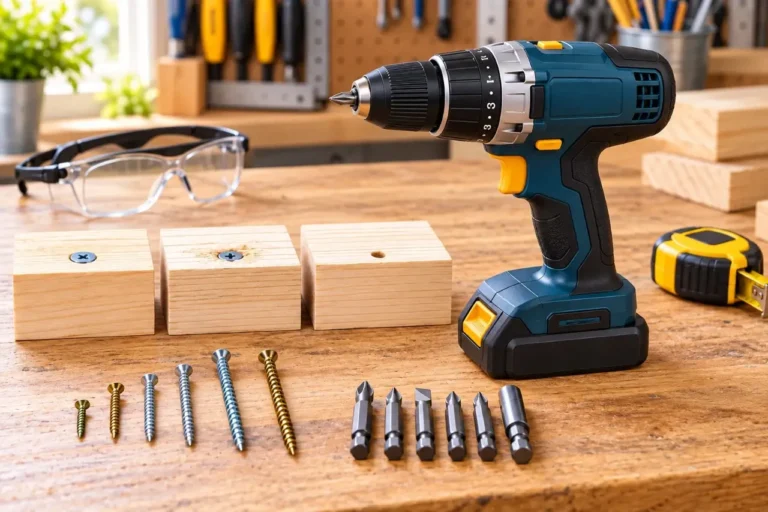
Head style should match the job. A flat-head screw can sit flush in a countersink. A pan-head screw is useful where the head should bear on hardware rather than disappear into the wood. Washer-head designs provide a wider bearing surface.
The screw also needs enough thread engagement in the receiving piece. In many two-board joints, a clearance hole through the first piece allows the screw to pull the parts together instead of threading into both pieces and leaving a gap.
Pilot holes reduce splitting risk
Pilot holes are especially useful near board ends and edges, in dense hardwood, and with larger conventional screws. The correct pilot diameter depends on the screw geometry, wood density, and manufacturer guidance, so avoid using one universal pilot-hole rule.
See Ulverion’s guide to preventing wood splitting when drilling for pilot-hole and edge-splitting guidance.
For flat-head screws, countersink only as much as needed for the head to seat correctly. Cutting an unnecessarily deep recess removes wood that would otherwise support the head.
Match the screw to the environment
Indoor wood screws are not automatically suitable outdoors. Exterior projects need fasteners whose material or coating is rated for the expected moisture exposure and the wood being used.
Pressure-treated lumber deserves extra attention because some preservatives can increase corrosion risk. Do not assume that every screw labeled “exterior” is compatible with every treated-lumber formulation. Follow the lumber supplier’s and fastener manufacturer’s corrosion guidance.
For decks, railings, framing repairs, ledgers, handrails, or other safety-critical or load-bearing connections, use the fastener type specified by the plans, hardware manufacturer, code-approved connection, or qualified professional. A general-purpose wood screw should not be treated as a structural screw unless it is specifically evaluated for that application.
Can you use drywall screws for wood?
For general woodworking, choose a screw designed for wood instead.
Drywall screws are hardened for fast driving into drywall systems, but that hardness can make many of them less tolerant of bending and side loads than screws designed for wood assembly. Their bugle heads also provide a different bearing shape than many wood-screw heads, and common drywall finishes are not intended for exterior exposure.
That makes drywall screws a poor substitute for loaded furniture joints, shelves that carry significant weight, outdoor projects, framing repairs, decks, railings, or safety-critical attachments.
Engineered wood products add another variable. MDF, particleboard, plywood, and composite panels can require different screw geometries and pilot-hole practices. Use the fastener or hardware manufacturer’s instructions instead of assuming one ordinary wood screw fits every panel.
Can you use wood screws for drywall?
Not for hanging gypsum panels unless the drywall system specifically permits that fastener.
A typical wood screw does not have the same head geometry as a drywall screw. A flat head can cut the paper as it seats, while a pan or washer head can remain too proud for normal drywall finishing. More importantly, gypsum-panel systems can specify the fastener type, spacing, and penetration required for that assembly.
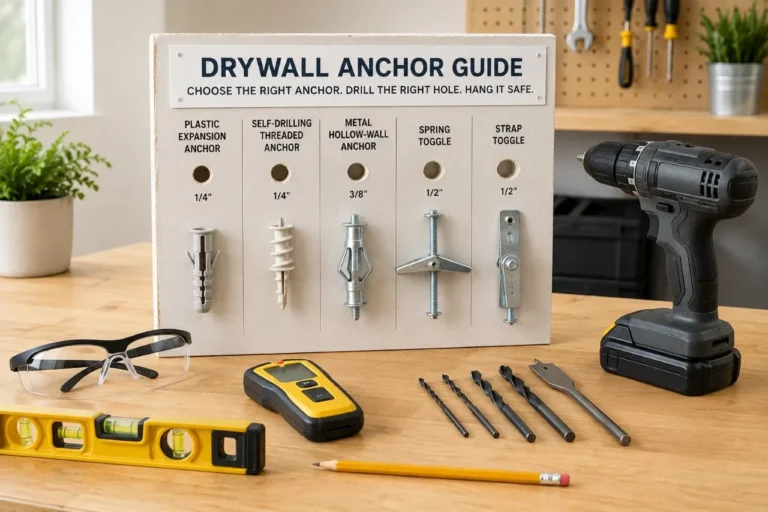
Mounting an object on an already finished drywall wall is a different task. In that case, use the fixture manufacturer’s approved method, which may involve fastening into framing or using a suitable hollow-wall anchor. See Ulverion’s guide to installing drywall anchors for that separate application.
How to choose the right screw
Before driving a screw, answer these questions:
- What material am I fastening? Drywall, solid wood, plywood, MDF, steel framing, and masonry need different fastener designs.
- What is the screw fastening into? The receiving material determines the thread and anchoring method.
- Is the connection load-bearing or safety-critical? If yes, use the specified structural or hardware-approved fastener rather than a drywall screw or an unverified general-purpose wood screw.
- Is the location damp, exterior, or pressure-treated? Check the fastener’s corrosion rating and material compatibility.
- Does the project or manufacturer specify a fastener? Follow that instruction instead of substituting a similar-looking screw.
Common mistakes to avoid
Driving drywall screws too deep: Stop once the head is slightly recessed and the paper remains intact. If the paper tears badly, add a properly placed replacement fastener according to the drywall instructions.
Skipping a pilot hole in vulnerable wood: If a board begins to split, stop. Remove the screw, reassess the location, and drill the pilot hole recommended for the fastener and material.
Using the wrong driver bit: A worn or poorly fitting bit can cam out and damage the screw head. If that has already happened, see how to remove a stripped screw without more damage.
Using a screw that is too long in a wall: A long fastener can reach wiring, plumbing, ductwork, or protective metal plates. Consider what is behind the surface before drilling or driving. If the screw or bit meets unexpected hard resistance, stop and identify the obstruction. Never force through a metal plate placed to protect concealed utilities.
Assuming “wood screw” means “structural screw”: Structural connections need fasteners evaluated and specified for the connection. Similar appearance does not mean equivalent strength or approval.
Wear safety glasses when driving or removing screws, clamp small workpieces instead of holding them by hand, and keep your free hand out of the fastener path.
The practical rule is simple: match the screw to the material, load, environment, and manufacturer instructions. Drywall screws belong in drywall systems. Wood screws belong in suitable wood connections. When the connection carries meaningful load, step beyond those broad categories and use the fastener specifically approved for the job.
Ulverion is reader-supported. Your support allows us to research tools, create practical guides, and share reliable DIY advice for homeowners, makers, and workshop enthusiasts.