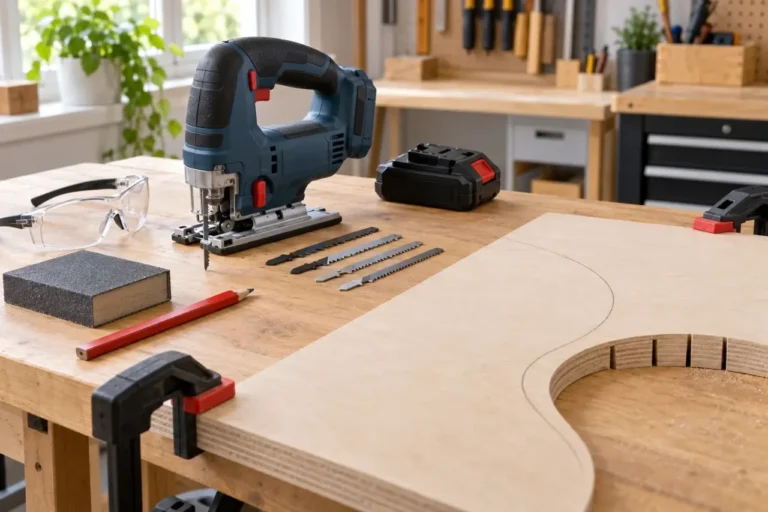

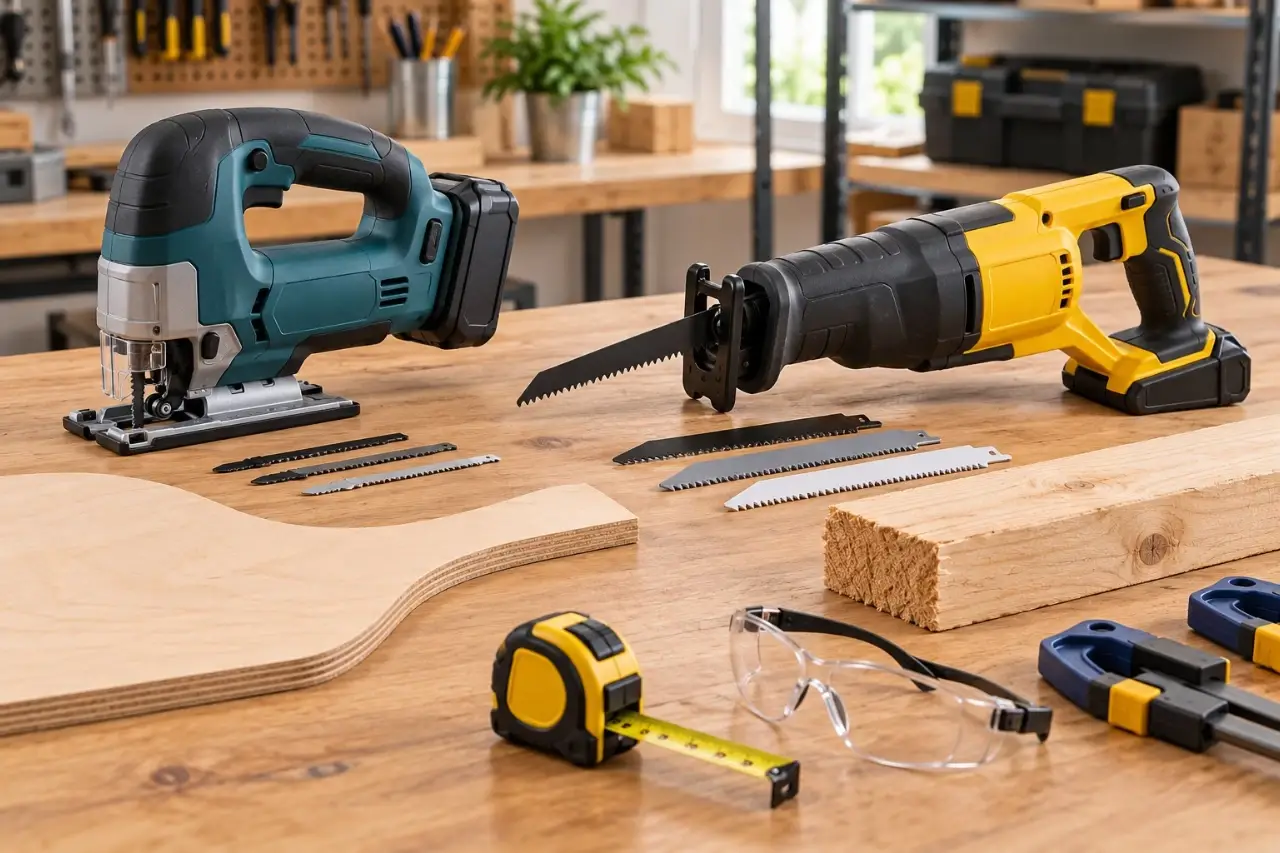
A jigsaw is the better choice when you need controlled, reasonably clean cuts in sheet goods, curves, and interior openings.
A reciprocating saw is built for fast, rough cutting where access is awkward or the material may contain nails, such as demolition, pruning, and cutting pipes.
In a jigsaw vs reciprocating saw decision, the right tool depends less on which is more powerful and more on how much control the cut requires.
Jigsaw vs Reciprocating Saw at a Glance
Both tools use a narrow blade that moves back and forth in a reciprocating motion. The major difference is how the tool supports and guides the blade.
A jigsaw has a flat base, often called a shoe, that rests on the workpiece. This gives you a stable reference surface for following a line. Its short blade projects below the shoe, making it suited to plywood, lumber, countertop material, plastic, and thin metal when fitted with the correct blade.
A reciprocating saw has a pivoting shoe at the front, but it is not designed to ride flat across a sheet while you follow a precise line. Its long, exposed blade reaches into tight spaces and around obstructions. That makes it valuable for rough removal work, but harder to control for finish cuts.
| Task | Better tool | Why |
|---|---|---|
| Cutting a curved line in plywood | Jigsaw | The shoe supports the tool and helps guide the blade. |
| Making a sink opening in a countertop | Jigsaw | It can start from a drilled hole and follow a marked layout. |
| Cutting a nail-embedded 2×4 during removal | Reciprocating saw | Long demolition blades tolerate rough work and reach between materials. |
| Trimming a PVC pipe close to a wall | Reciprocating saw | The blade can reach into confined areas. |
| Cutting thin sheet metal to a layout line | Jigsaw | A fine-tooth metal blade provides more control. |
| Pruning a branch | Reciprocating saw | The long blade reaches around the branch and works in less stable positions. |
Choose a Jigsaw for Accuracy and Curves
Choose a jigsaw when the cut line matters, the shape includes curves, or the finished edge will remain visible. It is not a substitute for stationary woodworking equipment, but with a sharp blade, proper support, and a controlled feed rate, it can produce clean, useful cuts for many home projects.
A jigsaw is particularly practical for cutting curves in plywood, notching flooring around a pipe, making cutouts in cabinet backs, and trimming laminate or plastic paneling with the appropriate blade. It can also make a plunge cut, meaning a cut started away from an edge, but the safer and cleaner approach for most beginners is to drill a starter hole large enough for the blade.
What limits a jigsaw
Jigsaw blades can bend sideways, especially in thick stock, dense hardwood, or when you push the tool too quickly. The cut may look correct on top while the blade exits several degrees off the line underneath. This is called blade deflection.
For a straighter cut, support the material close to the cut line, use a blade long enough to extend through the material at full stroke, and let the blade cut at its own pace. If a straight, long, highly accurate cut is the goal, a circular saw with a guide or a track saw is usually more appropriate than either tool in this comparison.
Choose a Reciprocating Saw for Reach and Removal
A reciprocating saw is the practical choice when the work is too rough, cramped, or obstructed for a jigsaw. It excels at cutting through framing during non-structural removal, slicing old fasteners, cutting metal or plastic pipe where permitted, and pruning branches with a suitable pruning blade.
The reciprocating saw’s long, exposed blade is its main advantage. You can cut a pipe inside a wall cavity after confirming the area is safe, or reach behind a nailed board during demolition. It also accepts blades made for wood with nails, metal, cast iron, plastic, and pruning. The blade type matters as much as the saw itself.
What limits a reciprocating saw
A reciprocating saw produces vibration and requires two-handed control. It is not the right choice for a clean countertop opening, detailed curve, or a finished plywood edge. The blade can catch, bend, or strike hidden material if the work moves or the shoe is not held firmly against the surface.
It can also damage more than intended. When cutting a wall, floor, or ceiling assembly, the blade may extend well beyond the material you can see. Stop before cutting if there could be concealed wiring, plumbing, gas piping, or other utilities. A qualified professional should handle work where the hazard cannot be identified or safely isolated.
Match the Blade to the Material
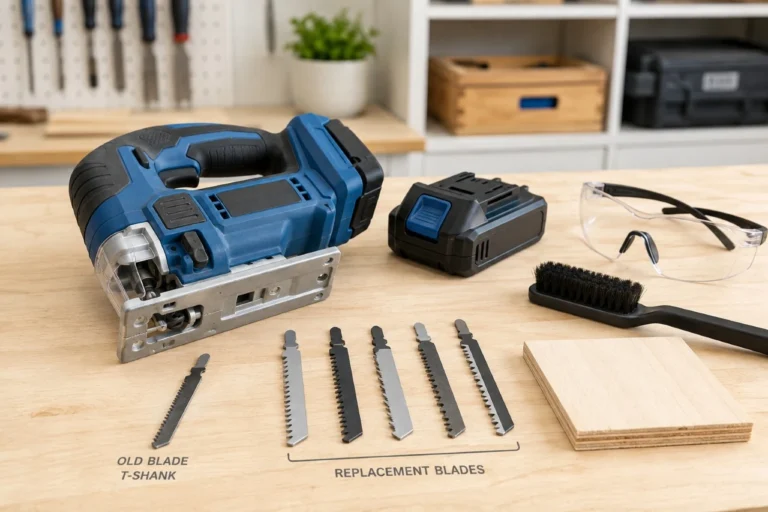
A good saw with the wrong blade performs poorly. Check your tool manual for the approved blade shank and blade-length limits before installing any blade. Never force a blade that does not fit the tool’s clamp.
For a jigsaw, wood blades with fewer, larger teeth cut quickly but leave a rougher edge. Fine-tooth blades cut more slowly and can reduce splintering in plywood or laminate. Metal-cutting blades have smaller, closely spaced teeth. A down-cut jigsaw blade can leave a cleaner top face on veneered sheet goods, though it may increase splintering on the underside.
For a reciprocating saw, use a wood-demolition blade for lumber that may contain nails, a fine-tooth metal blade for metal, and a blade specifically marked for pruning when cutting green branches. Longer blades improve reach, but excessive length creates more vibration and can make the cut less controlled. Use only enough blade length to clear the material and any expected gap behind it.


How to Make a Controlled Cut
The setup is different for each saw, but the same principle applies: secure the work and keep the blade from being pinched.
- Mark the cut line and check both sides of the material. Look for screws, nails, wires, pipes, and anything that could be damaged by the blade.
- Clamp or otherwise stabilize the workpiece. Do not hold small material in one hand while operating either saw with the other.
- Install a blade rated for the material and inspect it for bent teeth, cracks, or heavy wear. Replace damaged blades.
- Put on safety glasses and hearing protection. Use a properly fitted dust mask or respirator when cutting materials that create fine dust, following the material and tool manufacturer guidance.
- For a jigsaw, place the shoe flat on the work before starting. For a reciprocating saw, press the pivoting shoe firmly against the work to reduce vibration and blade chatter.
- Start slowly, establish the kerf, then use a steady feed. A kerf is the narrow slot left by the blade. Forcing either saw overheats the blade, reduces control, and can bend it.
Keep your hands clear of the expected blade path and the underside of the work. With a reciprocating saw, account for the full blade stroke beyond the material. With a jigsaw, wait for the blade to stop before lifting the tool away from the cut.
Common Problems and Simple Fixes
If a jigsaw keeps wandering off the line, the usual causes are a dull or narrow blade, feeding too fast, unsupported material, or a blade that is too short for the material thickness. Try a new, wider blade designed for the cut and slow down. If the bottom of the cut is badly angled, reduce orbital action if your saw has that setting and use a slower, more controlled feed.
If a reciprocating saw shakes violently, make sure its shoe is contacting the work. Vibration rises when the workpiece is loose, the blade is too long, or the blade is dull. Reposition the work if possible, use a shorter appropriate blade, and avoid twisting the blade in the kerf.
Burn marks, melting plastic, or blue discoloration on a metal blade usually mean excess heat. Stop, allow the blade to cool, and reassess the blade type and cutting speed. Continuing can ruin the blade and damage the workpiece.
Safety Boundaries Worth Respecting
Neither saw should be used on material that may contain asbestos or lead-based paint without appropriate assessment and controls. Do not cut unknown wall cavities or concealed building components just to see what is behind them. For older homes, utility locations and hazardous materials deserve extra caution.
Avoid using a reciprocating saw for structural framing removal unless the work has been evaluated by a qualified professional. A single cut can affect load paths in ways that are not visible. Likewise, follow the tool manual for blade changes, battery use, cord condition, and service requirements.
The practical rule is simple: use a jigsaw when control and cut quality matter most, and use a reciprocating saw when access, speed, and rough-cut capability matter more. Taking an extra minute to secure the work and choose the blade usually makes the cut safer and cleaner than switching to a more aggressive tool.
Ulverion is reader-supported. Your support allows us to research tools, create practical guides, and share reliable DIY advice for homeowners, makers, and workshop enthusiasts.